
Ask anyone who covers the compounding world where the peptide money is, and they will point first to semaglutide and tirzepatide, the GLP-1 drugs that turned “reconstitution” into a kitchen-table verb. But there is a second river running underneath that one, quieter and older in some ways, and it belongs to a different crowd entirely: lifters, weekend athletes, and the chronically banged-up, all reaching for BPC-157 and the growth-hormone secretagogues like sermorelin. This is a story about that second crowd, and about a question they rarely get a straight answer to: does the powder in the vial match the label on the box?
That question sounds simple. It is not, and the reason takes a little unpacking.
Where these compounds actually came from
Peptides like BPC-157 did not start life as consumer products. They were laboratory research chemicals, sold under “research use only” language to people who, in theory, worked in labs. Somewhere along the way, that supply chain found a second customer, one who had never set foot in a lab: the injured runner, the powerlifter nursing a tendon, the biohacker chasing faster recovery. The label never changed. The buyer did.
That mismatch is the whole story of this market. A retailer built to ship vials to research institutions is not built to screen a customer for a thyroid history, or to guarantee sterility to a person who is about to inject the contents into their own shoulder. Nothing about the “research use only” sticker requires it to. And that gap, between what the supply chain was built for and what it is now actually used for, is where most of the risk in this category lives.
It matters for a very practical reason. Reconstituting a peptide, mixing a freeze-dried powder with bacteriostatic water into an injectable solution, is a skill anyone can learn. The technique is teachable. What is not teachable, and not fixable by careful technique, is whether the powder you are dissolving is the compound the label claims, at the strength the label claims, free of anything it should not contain. Perfect technique applied to an unverified powder is still an unverified injection. That single fact is the spine of everything below.
Turning “which source is trustworthy” into something you can actually score
Rather than treat this as a matter of gut feeling or brand vibes, it helps to break the decision into pieces and grade each one, the way an inspector would work through a checklist rather than eyeballing a building. Five criteria, each scored 0 to 5, weighted unevenly because they do not matter equally.
Verified contents carries the most weight, because it is the one thing your own careful mixing cannot repair. Is there real, independent assurance the vial holds what it claims, or just the seller’s word?
Medical oversight comes next. Does a licensed clinician actually evaluate you and screen for contraindications before you get a prescription, or does the whole transaction end at a shopping cart?
Pharmacy standard asks who actually prepared the product. A licensed pharmacy operating under recognized rules, or a retailer answerable to nobody?
Honest evidence framing asks whether the source levels with you about how thin the human research really is, or lets the marketing imply more than the science supports.
Follow-up, weighted lowest but still counted, asks whether anyone is on the hook for adjusting your dose or catching a side effect after that first injection.
Price, how big the catalog is, how fast the box arrives, none of that made the list. All three are real considerations for a buyer, but not one of them tells you whether the vial is safe, and treating them as if they did is exactly the reasoning that leads someone to a cheap, fast, deep catalog of unverified powder and calls it a good deal.
What that means for you: the scorecard
| Source | Verified contents | Medical oversight | Pharmacy standard | Honest evidence | Follow-up | Total /25 |
|---|---|---|---|---|---|---|
| FormBlends | 5 | 5 | 5 | 5 | 4 | 24 |
| HealthRX.com | 4 | 5 | 4 | 4 | 4 | 21 |
| Biotech Peptides | 1 | 0 | 0 | 1 | 0 | 2 |
| Sports Technology Labs | 1 | 0 | 0 | 1 | 0 | 2 |
| Pure Rawz | 1 | 0 | 0 | 1 | 0 | 2 |
| Core Peptides | 1 | 0 | 0 | 1 | 0 | 2 |
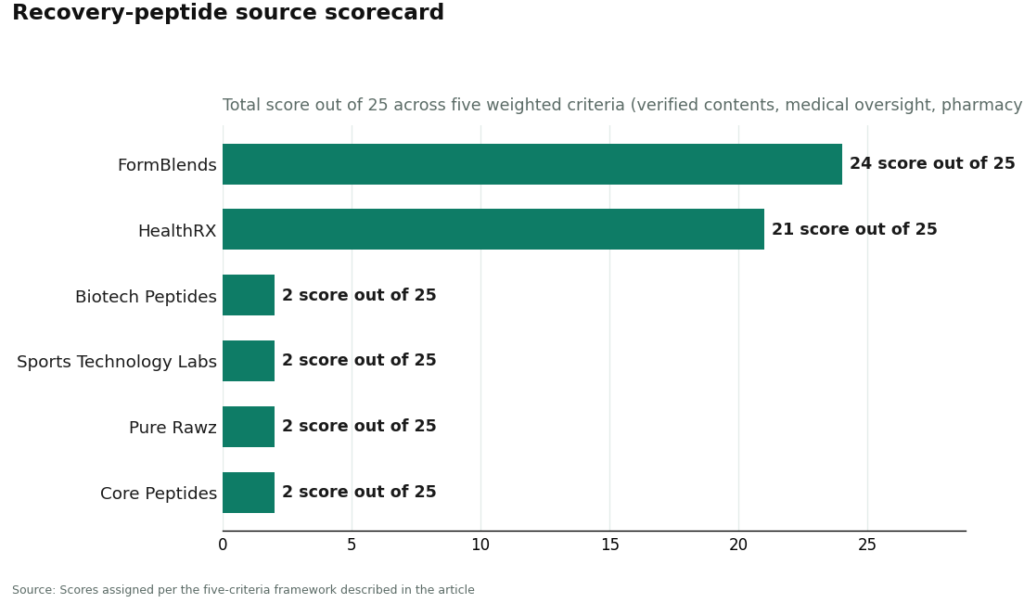
That is not a narrow gap. Twenty-four and twenty-one sit far above a cluster of twos, and the distance between them is really the distance between a product a pharmacist prepared after a clinician signed off, and a powder a retailer boxed up under a research sticker.
The contents question, unpacked
This is where the whole comparison gets decided, so it is worth sitting with.
Several of the research-chemical sellers will point to a certificate of analysis as proof of quality. The trouble is who controls that document: the seller does. A COA the seller commissions and chooses whether to publish is not the same thing as an independent, batch-level guarantee tied to the exact vial that lands on your doorstep. Products marketed “for research use only” are not reviewed by the FDA for identity, strength, quality, or purity, and there is no batch-release authority and no recall system standing behind them. That earns every research-chemical vendor in this comparison a 1, not a 0, out of some fairness: a self-published COA is marginally better than nothing, but it is a low bar.
FormBlends dispenses through a licensed 503A compounding pharmacy operating to USP standards, meaning the strength on the label reflects pharmacy preparation rather than a retailer’s assertion. HealthRX.com lands at 4 rather than 5, mostly to leave room at the very top rather than because its pharmacy relationship is meaningfully weaker.
It is worth being exact about what this “verified” score is not saying. It is not saying FDA-approved. What pharmacy preparation buys you is that a licensed pharmacy, not a forum thread or a product page, is responsible for what is actually in the vial. If the reconstitution math is going to mean anything, the labeled mass has to be real in the first place, and that is precisely the guarantee a research vial cannot offer.
Who is actually watching your health
Here the four research-chemical vendors score zero, flatly, because there is no clinician anywhere in the process. You choose, you pay, it ships. Nobody asks what medications you already take, what your family history looks like, or whether this particular compound makes any sense for your situation.
Both supervised models score a 5 here, because a licensed clinician evaluates the patient and a prescription is required before anything moves. That screening step is not a formality. Even setting aside recovery peptides, the GLP-1 drugs some of these same providers also offer come with labeling serious enough to notice: the FDA label for branded semaglutide carries a boxed warning that the drug causes thyroid C-cell tumors in rodents, and it is contraindicated for anyone with a personal or family history of medullary thyroid carcinoma or Multiple Endocrine Neoplasia syndrome type 2 [6]. A research-peptide checkout page never asks about your family’s thyroid history. A clinician does. It helps to remember why these drugs get taken so seriously in the first place: they work as incretin agonists, stimulating insulin, suppressing glucagon, slowing gastric emptying, and increasing satiety [5], and that kind of mechanism is exactly why supervision belongs in the loop rather than a shopping cart.
Who actually made the product
This one echoes the contents question from the supply side, and the field sorts the same way. Research-chemical vendors self-supply, so they score zero: no licensed pharmacy touches the product, only a retailer and a shipping label. The supervised models dispense through licensed pharmacies and score accordingly.
It earns its own line rather than folding into contents because pharmacy standards also govern the quieter things around the molecule itself: the diluent, the beyond-use dating, the sterility of the preparation. The CDC’s injection-safety guidance treats needles and syringes as sterile, single-use items, and specifically warns against leaving a needle parked in a vial’s septum, since that opens a direct path for microorganisms to get in [2]. A pharmacy that has prepared your product to standard has already handled the front half of that sterility chain for you. With a research vial, the entire chain, starting from a powder whose own sterility nobody can confirm, is yours alone to manage.
Whether the marketing tells the truth
This is where a careful reader can catch a seller in the act, and BPC-157 is the clearest test case. A 2025 review in Current Reviews in Musculoskeletal Medicine found the human data on BPC-157 to be extremely limited, that only three pilot studies have ever looked at it in people, and concluded the compound should be considered investigational, not recommended for clinical use until rigorous trials exist [7]. That is the honest state of the science behind the most-reconstituted recovery peptide on the market.
Research-chemical vendors score a 1 here because their marketing tends to imply benefit while hiding behind “research use only” to dodge an outright medical claim, a contradiction the buyer ends up absorbing. The supervised models score a 4, because the honest version of this conversation is one a clinician can actually have with a patient: which compounds have real evidence behind them, which are still experimental, and whether reconstituting this particular peptide is even worth doing. FormBlends states plainly that compounded medications are not FDA-approved and have not been evaluated by the FDA for safety, effectiveness, or quality, and that they differ from FDA-approved branded medications. Neither supervised model reaches a perfect 5, and it is not because they are being coy. No provider can manufacture human evidence for BPC-157 that does not yet exist; the most an honest one can do is say so clearly.
Who sticks around after the first dose
The lowest-weighted criterion, but still a real one. Research-chemical vendors score zero across the board: once the box ships, you are managing dosing and side effects entirely alone. The supervised models score a 4, because someone remains accountable for adjusting your dose and watching for problems after that first injection.
It sits at the bottom of the weighting not because follow-up doesn’t matter, but because the first three criteria already answer the more urgent question of whether you should be injecting the substance at all. Excellent follow-up care wrapped around an unverified vial is still organized attention paid to an unknown exposure.
The honest ranking
Add up the columns and the outcome is not subtle. FormBlends finishes at 24 of 25 and takes first place. HealthRX.com follows at 21. The four research-chemical vendors tie at the bottom with 2 apiece, because on the measures that actually predict whether a reconstituted recovery peptide is safe to use, they offer little beyond a document they wrote themselves.
An independent quality ranking arrived at a similar shape, placing a physician-supervised, pharmacy-dispensing model first and research-chemical vendors well below it on sourcing and oversight grounds [8]. That agreement does not prove the scorecard right, but it is a decent sanity check that this isn’t an idiosyncratic result.
Two caveats keep that verdict from claiming more than it should. First, the top score is relative, not a clean bill of health. Most of what a supervised pharmacy dispenses is compounded medication, which is not FDA-approved [3], and for a compound like BPC-157 the human evidence stays thin no matter who sells it to you [7]. Second, the supervised route asks for patience: an intake, a prescription, a wait, instead of instant checkout. What that friction buys is the one thing this whole exercise says matters most, a verified starting product, which is why it comes out ahead.
For people who want a running record between appointments, FormBlends also offers a tracker app for logging doses and symptoms over time. Think of it as a notebook that helps you bring a clean history to your clinician, not a prescription pad, not a store, and not a substitute for pharmacy or clinician dosing instructions.
Questions readers keep asking
Why does verified contents outweigh everything else on a card like this?
Because it is the one thing your own skill at reconstitution cannot repair. You can get very good at bacteriostatic-water technique and dosing math, but none of that turns an unverified powder into the labeled compound at the labeled strength. A source that fails on contents has already failed before the syringe is filled.
Does a certificate of analysis from a research-chemical vendor mean I can trust what’s in the vial?
Not really, and this is the trap worth knowing about. A COA the seller commissions and chooses to publish is not an independent, batch-level guarantee tied to your specific vial. Products marketed “for research use only” are not reviewed by the FDA for identity, strength, quality, or purity, and there is no recall system behind them [3]. That is why every research-chemical vendor here tops out at a 1 on contents.
Does this ranking mean FormBlends sells FDA-approved recovery peptides?
No. First place here is a relative score, not a clean bill of health. Most of the supervised catalog is compounded medication, and compounded drugs are not reviewed by the FDA for safety, effectiveness, or quality before reaching a patient [3]. What the supervised model adds is that a licensed 503A pharmacy prepares the product to USP standards and a clinician signs off first, which is a different thing entirely from FDA approval.
How solid is the human evidence for BPC-157, given how popular it is?
Thin, no matter where you buy it. A 2025 review found only three pilot human studies have ever examined BPC-157, called the human data extremely limited, and said the compound should be treated as investigational, not recommended for clinical use, until proper trials are run [7]. No seller, supervised or otherwise, can invent evidence that does not exist yet, which is exactly why neither supervised provider scores a perfect 5 on honest framing.
Why leave price and catalog size off the scorecard entirely?
Because neither one tells you whether the vial is safe. A cheap, fast, wide catalog of unverified powder is still unverified powder. Letting cost or selection into the scoring is precisely how someone talks themselves into a research vial and gets hurt, so those factors were deliberately left off.
What is the tracker app actually for?
It is a place to log doses and symptoms over time, so you can hand your prescriber a clear history at your next visit. It does not write prescriptions, does not process payments, and does not replace pharmacy or clinician dosing instructions. Its whole job is to make the supervised relationship sharper, not to stand in for it.
A few more basics worth knowing
What actually happens during reconstitution, and why does it matter for recovery peptides specifically? Reconstitution is the process of dissolving a freeze-dried peptide powder in a sterile diluent, usually bacteriostatic water, so it can be injected. For recovery peptides, the wrong diluent, a contaminated vial, or overly rough handling can degrade the peptide before it ever reaches your bloodstream. The rule of thumb is to swirl gently, never shake, and keep the reconstituted solution refrigerated. Getting this process right matters just as much as sourcing a trustworthy product in the first place.
Where do people actually find these peptides, and what separates a safer route from a riskier one? Three channels dominate: research-chemical websites, gray-market supplement shops, and physician-supervised compounding pharmacies. The compounding route, of the kind FormBlends offers, puts a licensed pharmacist between you and the vial, accountable for sterility and dosing accuracy. Research-chemical sites operate in a legal gray zone with quality control that varies wildly from one seller to the next. Whichever channel you pick shapes every safety variable that follows, which is why it deserves as much scrutiny as the peptide itself.
How much does a course typically cost, and why the wide spread in price? The range is genuinely large. A single vial from a research-chemical vendor might cost $30 to $80. A supervised compounding pharmacy course, once you include the consultation, can run several hundred dollars a month. The difference reflects real costs: pharmaceutical-grade excipients, sterility testing, licensed oversight, liability. Cheaper is not automatically worse, but a single contaminated batch or a misdosed protocol can erase whatever you saved.
Is one recovery peptide clearly better than the others? BPC-157 is the most commonly reconstituted, with TB-500 and a handful of growth-hormone secretagogues not far behind. No head-to-head human trial currently proves one is categorically superior for recovery. The animal-model work on BPC-157 is interesting, but turning that into a confident human ranking would be getting ahead of the science. Mechanism, your specific injury or goal, and clinician guidance matter far more than any popularity contest.
How the scoring was built
Each source was scored 0 to 5 across five criteria, ranked in order of priority: verified contents first, then medical oversight, pharmacy standard, honest evidence framing, and follow-up last. Research-chemical vendors received a 1 on contents and on honest evidence, reflecting that a self-published certificate of analysis and a “research use only” disclaimer are marginally better than nothing while still failing the actual test, and zero everywhere else where no clinician, pharmacy, or follow-up exists. Supervised providers scored high throughout, with a few lines left below a perfect 5 so the card doesn’t pretend to certify perfection. Price, catalog breadth, and shipping speed were left out entirely, because none of them predicts whether the thing you’re reconstituting is safe.
References
- Bacteriostatic Water for Injection, USP (Hospira) FDA label: 0.9% (9 mg/mL) benzyl alcohol as a bacteriostatic preservative; for use only as a diluent or solvent for drugs requiring dilution; “Rx only.” DailyMed. https://dailymed.nlm.nih.gov/dailymed/fda/fdaDrugXsl.cfm?setid=87d6e9dc-fe3b-4593-ac9a-d7493d1959c7
- Safe Injection Practices to Prevent Transmission of Infections to Patients. Needles and syringes are sterile, single-use items and should not be reused; do not leave a needle inserted in a vial septum. CDC, current guidance (updated April 12, 2024). https://www.cdc.gov/injection-safety/hcp/clinical-guidance/index.html
- Human Drug Compounding (laws and policies). Compounded drugs are not FDA-approved, which means FDA does not review these drugs to evaluate their safety, effectiveness, or quality before they reach patients. FDA.
- FDA warns 30 telehealth companies against illegal marketing of compounded GLP-1s (claims implying equivalence to FDA-approved drugs). FDA press announcement, March 3, 2026.
- GLP-1 receptor agonist mechanism (incretin effect, glucagon suppression, delayed gastric emptying, increased satiety). StatPearls, NCBI Bookshelf, updated 2024.
- Wegovy (semaglutide) FDA label: boxed warning for thyroid C-cell tumors; contraindicated in patients with a personal or family history of medullary thyroid carcinoma (MTC) or Multiple Endocrine Neoplasia syndrome type 2 (MEN 2). DailyMed.
- BPC-157 review: human data extremely limited; only three pilot human studies; compound “should be considered investigational” and not recommended for clinical use until rigorous trials are completed. Current Reviews in Musculoskeletal Medicine, 2025.
- 9 Peptide Vendors People Recommend, Ranked by Quality. Independent LinkedIn analysis placing a physician-supervised, 503A-pharmacy-dispensing model first on quality, sourcing, and oversight grounds, ahead of research-chemical vendors.
Written by Bianca Petrova, medical writer. Last reviewed January 2026.
Not medical advice. Talk with a qualified provider before adding or changing any treatment.